Can I Use US Dollars in India? The Complete Guide to Currency, ATMs, and Exchange Rates
 May, 22 2026
India Travel Currency & Customs Calculator
Trip Details
Financial Breakdown
| Item | Value |
|---|---|
| Base Conversion Amount | ₹0.00 |
| Exchange Fee (0%) | - ₹0.00 |
| Total Rupees Received | ₹0.00 |
Recommendation will appear here.
Enter your details to see how much INR you will receive and check customs requirements.
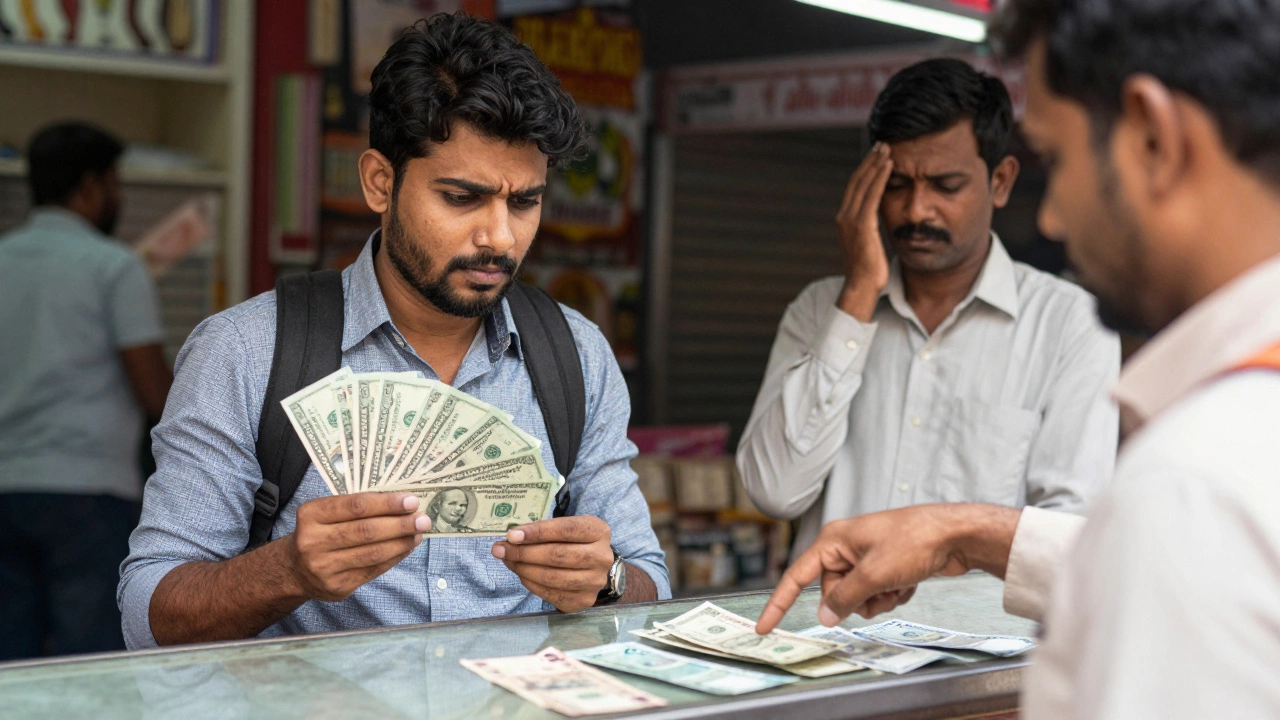
Imagine standing at a bustling street stall in Jaipur, ready to buy some incredible handmade jewelry. You pull out a crisp $20 bill, expecting the vendor to smile and hand over your purchase. Instead, they politely shake their head. "No USD," they say. "Only cash or card."
This is the reality for most travelers heading to India. While the United States Dollar (USD) is the world's reserve currency, it has zero purchasing power as direct payment in everyday transactions across India. You cannot pay for your rickshaw ride, your hotel room, or your chai with American bills. However, that doesn't mean you should panic about bringing cash from home. In fact, having a small amount of USD can be a strategic advantage if you know exactly how to use it.
The short answer is: No, you cannot spend US dollars directly in shops, restaurants, or transport. But yes, you can bring them into the country to exchange for Indian Rupees (INR), which is the only legal tender you will actually use. Here is everything you need to know to handle your money like a pro, avoiding scams and getting the best rates possible.
The Golden Rule: Only Indian Rupees Work
India operates on a strict single-currency system. The Indian Rupee (INR) is the sole legal tender. Whether you are in a high-end mall in Mumbai or a remote village in Kerala, prices are listed in Rupees, and payments must be made in Rupees.
There are very few exceptions where foreign currency might be accepted, and these are usually tourist traps designed to give you a bad deal. Some luxury hotels may allow you to settle your final bill in USD or Euros, but they will apply an exchange rate that is significantly worse than what you would get at a bank. Similarly, large tour operators might accept USD for booking packages, but again, the rate will be inflated. For daily survival-food, transport, shopping-you need INR.
Understanding this distinction is crucial. Your goal isn't to spend dollars; it's to convert them efficiently into rupees before you start spending. This mindset shift helps you avoid the temptation to accept poor exchange rates from unauthorized vendors who might claim they can take your dollars.
Where to Exchange US Dollars for Best Rates
If you decide to bring physical cash, timing and location matter immensely. Exchanging money at the airport upon arrival is convenient, but it is rarely the cheapest option. Airport kiosks operate with higher overheads and often offer less competitive rates because they know travelers are desperate for local cash immediately after landing.
Here is a breakdown of where you can exchange your USD:
- Airport Money Changers: Available at major hubs like Delhi (DEL), Mumbai (BOM), and Bangalore (BLR). Good for emergencies or small amounts (enough for a taxi and water), but expect a markup of 3-5% compared to city rates.
- Authorized Money Changers in City Centers: Cities have licensed exchange bureaus that offer much better rates. Look for signs saying "Authorized Dealer" or "Money Changer." These places are regulated by the Reserve Bank of India (RBI) and provide transparent rates.
- Banks: Major banks like State Bank of India (SBI), HDFC, and ICICI offer currency exchange services. They are safe and reliable, though their hours may be limited (often closed on Sundays and public holidays).
- Hotels: Most hotels offer exchange services for guests. While convenient, the rates are typically the worst available. Use this only if you have no other option.
Pro tip: If you are exchanging a large amount, compare rates between two or three authorized dealers in the city center. Even a difference of 1-2 Rupees per dollar adds up quickly if you are converting hundreds of dollars.
ATMs: The Smart Traveler’s Best Friend
While carrying cash has its place, relying solely on ATMs is often the most practical approach for modern travelers. India has a massive network of automated teller machines, even in smaller towns. Using your debit or credit card to withdraw INR directly from an ATM usually gives you a rate close to the interbank exchange rate, which is far superior to most street-side money changers.
However, there are catches. Many international banks charge foreign transaction fees and ATM usage fees. Additionally, Indian ATMs often have daily withdrawal limits, typically ranging from 10,000 to 25,000 INR depending on the bank and your account type. Always inform your bank before traveling to ensure your cards aren't blocked for suspicious activity abroad.
When using an ATM, you will be asked if you want "Dynamic Currency Conversion" (DCC). This is a trap. The machine will ask if you want to be charged in USD or INR. Always choose INR. If you choose USD, the ATM operator applies their own terrible exchange rate, costing you extra. Let your home bank handle the conversion; their rates are almost always better.
Credit and Debit Cards: Widely Accepted
You do not need to carry large amounts of cash. Card payments are widely accepted in urban areas. Visa and Mastercard are the kings of Indian payments. Almost every restaurant, hotel, department store, and larger shop accepts them. Contactless payments (tap-to-pay) are becoming increasingly common in metro cities like Delhi, Mumbai, and Bangalore.
For smaller transactions, however, cash is still king. Street vendors, auto-rickshaws, local buses, and small family-run eateries often do not accept cards. A good rule of thumb is to keep enough cash for daily expenses under 1,000 INR and use cards for larger purchases like hotel bills or expensive dinners.
Be aware that some smaller merchants may add a surcharge (usually 1-2%) for card payments due to merchant fees. It is worth asking beforehand if you are trying to save a few rupees.
Digital Payments: UPI and Mobile Wallets
India is a global leader in digital payments, primarily through a system called UPI (Unified Payments Interface). Apps like Google Pay (GPay), PhonePe, and Paytm dominate the landscape. Locals use QR codes to pay for everything from groceries to tea.
As a foreigner, accessing UPI directly is difficult. You generally need an Indian bank account and an Indian mobile number to register for these apps. However, some international versions of Google Pay and Apple Pay are starting to work with certain Indian merchants, particularly those that accept Visa/Mastercard contactless payments. Don't count on it being universal, but it is a growing trend.
Do not attempt to download Indian-specific apps like Paytm unless you have a local SIM card and bank account. Without these, you will not be able to link a funding source, rendering the app useless for payments.
How Much Cash Should You Bring?
There is no single right answer, but here is a practical framework:
- Arrival Essentials: Bring enough USD (or another major currency like EUR or GBP) to cover your first 24 hours. This includes taxi from the airport, water, snacks, and perhaps a small tip. Around $50-$100 in small denominations ($5, $10, $20) is ideal. Large bills like $100 are harder to break and sometimes rejected by small vendors due to fear of counterfeits.
- Emergency Buffer: Keep a separate stash of cash hidden away for emergencies. If your cards get stolen or lost, this buffer buys you time to sort things out.
- Rural Travel: If you plan to visit rural areas, small villages, or national parks, carry more cash. ATMs can be scarce, broken, or out of service in remote locations. In these areas, digital payments are also less reliable.
Remember, you can always withdraw more INR from ATMs during your trip. You cannot easily convert leftover INR back to USD when you leave, except at the airport within specific limits declared upon entry.
Customs Regulations and Declaration Limits
India has strict customs regulations regarding foreign currency. Understanding these rules prevents legal headaches at immigration.
| Item | Limit / Rule | Action Required |
|---|---|---|
| Foreign Currency Notes | Up to $5,000 USD equivalent | No declaration needed if below limit |
| Foreign Currency Notes | Over $5,000 USD equivalent | Must declare on General Declaration Form |
| Foreign Currency Notes | Over $10,000 USD equivalent | Must declare AND submit a Foreign Currency Declaration Form (FCDF) prior to departure from home country |
| Indian Rupee Notes | Maximum ₹25,000 INR | Cannot bring in more than this amount |
If you are carrying amounts above the thresholds, failing to declare them can result in confiscation, fines, or even detention. When in doubt, declare it. Customs officers appreciate honesty. Also, note that you cannot bring in old or damaged Indian Rupee notes. Any INR you bring in must be clean and undamaged.
Tips for Safe and Smooth Transactions
Navigating money matters in India requires vigilance. Here are some practical tips to keep your wallet secure and your stress levels low:
- Count Your Money: Always count your change in front of the vendor. It is not rude; it is expected. Mistakes happen, and once you walk away, you likely won't get your money back.
- Use Small Bills: Try to exchange your dollars for smaller denomination Rupee notes (₹10, ₹20, ₹50, ₹100). Vendors often struggle to give change for ₹500 or ₹2000 notes, especially for small purchases.
- Avoid Street Exchangers: Do not exchange money with people on the street or unlicensed shops. These operations are illegal, and you risk receiving counterfeit notes or being scammed on the rate.
- Keep Receipts: Save your exchange receipts. You may need them to prove the source of your funds if questioned, and they are essential if you wish to convert unused INR back to USD at the airport before leaving.
- Hygiene First: Indian currency, especially paper notes, can be dirty. Wash your hands after handling cash. Consider keeping a small bottle of hand sanitizer in your bag.
Finally, embrace the cash culture. While digital payments are growing, cash remains the lifeblood of the informal economy. Having physical Rupees allows you to engage with local markets, haggle for souvenirs, and enjoy the vibrant street food scene without friction. Plan ahead, exchange wisely, and travel confidently.
Can I use US dollars to pay for hotels in India?
Most hotels prefer payment in Indian Rupees via card or cash. Some high-end international chains may accept USD for the final bill, but they will use an unfavorable exchange rate. It is always better to pay in INR to save money.
Is it better to exchange money at the airport or in the city?
It is better to exchange a small amount at the airport for immediate needs (taxi, water) and then exchange the rest in the city. Authorized money changers in city centers offer significantly better exchange rates than airport kiosks.
Are credit cards accepted everywhere in India?
Credit cards are widely accepted in cities, malls, hotels, and larger restaurants. However, they are rarely accepted by street vendors, auto-rickshaws, local buses, and small shops. Always carry some cash for these smaller transactions.
What happens if I choose to be charged in USD at an ATM?
This is known as Dynamic Currency Conversion (DCC). If you choose to be charged in USD, the ATM provider applies their own poor exchange rate, costing you extra. Always choose to be charged in INR so your home bank handles the conversion at a better rate.
Can I bring Indian Rupees back to my home country?
You can take unused Indian Rupees out of India, but there are limits. Generally, you can take out up to ₹2,000 in notes or coins. To convert larger amounts of leftover INR back to USD, you must do so at the airport before departure and present your original exchange receipts.
Is it safe to use ATMs in India?
Yes, ATMs are generally safe, especially those located inside banks or in secure malls. Avoid standalone ATMs in isolated areas late at night. Shield your PIN when entering it, and check for any skimming devices attached to the card slot before inserting your card.
Do I need to declare my US dollars when entering India?
You must declare foreign currency if you are carrying more than $5,000 USD in notes or $10,000 USD in total value (including coins and traveler's checks). Amounts below $5,000 do not require declaration, but it is wise to keep records of your cash.