How Early Should I Book Tickets to India? The Ultimate Timing Guide
 May, 8 2026
India Flight Booking Timing Calculator
Your Booking Window
Pro Tips for Your Trip
There is nothing more frustrating than watching the price of a flight to Mumbai or Delhi climb by hundreds of dollars while you hesitate. You know you want to go. You have the vacation days planned. But every time you check the search engine, the number gets uglier. So, how early should you actually book tickets to India?
The short answer? For most international travelers, the sweet spot is between two and four months before departure. Booking too early often means paying a premium for uncertainty, while waiting until the last minute usually results in panic pricing. But India is a massive subcontinent with distinct seasons, regional hubs, and complex airline networks. A one-size-fits-all approach rarely works here.
To get the best deal, you need to understand the mechanics of airline pricing, the impact of Indian holidays, and which routes are notoriously expensive. Let’s break down exactly when to click that 'buy' button so you can spend your money on street food and heritage tours instead of airfare.
The Golden Window: When Airlines Drop Prices
Airlines don’t set prices randomly. They use revenue management systems that predict demand based on historical data. For long-haul routes like those connecting North America or Europe to India, these systems generally open bookings about 330 days in advance. However, the lowest fares rarely appear on day one.
Research from major travel analytics firms suggests that for international flights, the 'prime booking window' opens roughly 70 to 110 days before your trip. This is when airlines have enough data to gauge interest but still need to fill seats. If you are planning a trip for October, start looking seriously in June or July.
If you wait past the 60-day mark, the algorithm assumes you are either flexible (unlikely) or desperate (very likely). Prices tend to tick up weekly as the departure date approaches. Conversely, booking six to eight months out is often a waste of mental energy. You might see a fare, but it will likely be the standard economy rate, not the discounted promotional fare that drops closer to the date.
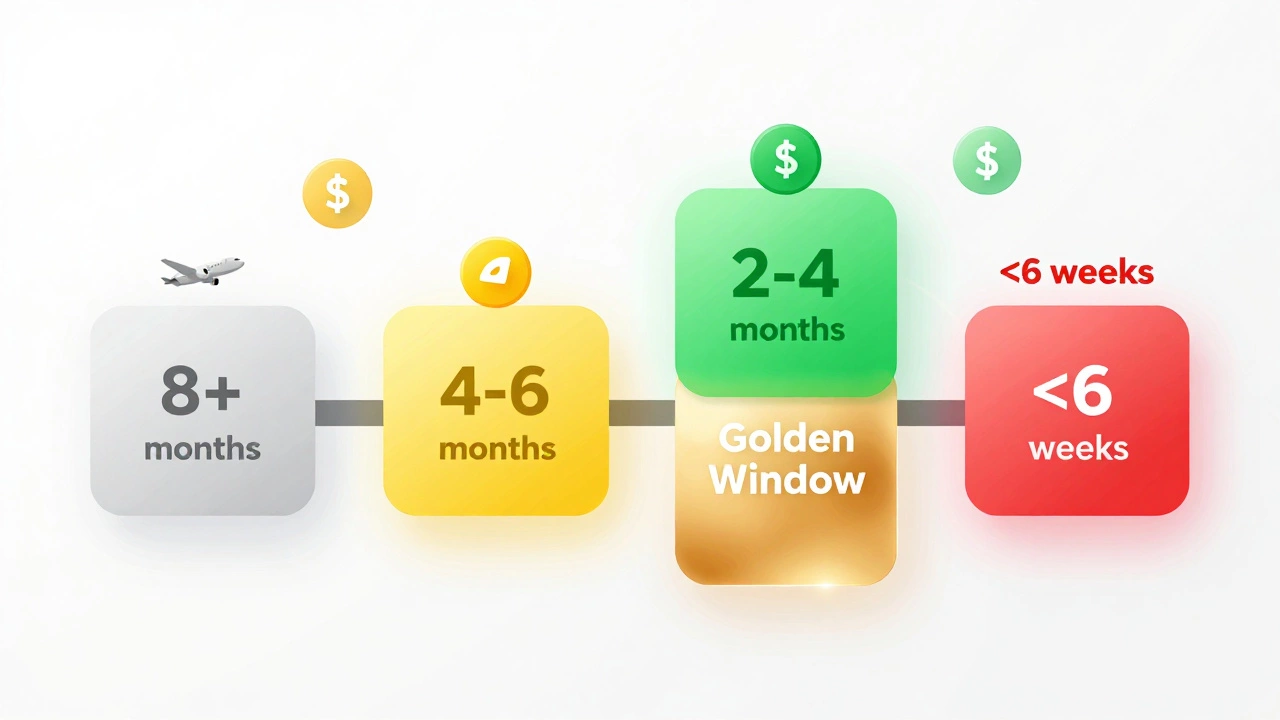
- 8+ months out: Standard pricing. Good for locking in dates if you have zero flexibility, but rarely the cheapest option.
- 4-6 months out: Monitoring phase. Set alerts. Prices may fluctuate.
- 2-4 months out: The Sweet Spot. Best balance of availability and low fares.
- Less than 6 weeks: Premium pricing. Expect to pay significantly more unless you find a rare error fare.
Seasonality Matters: Monsoon vs. Peak Season
India’s climate dictates its tourism flow, which directly impacts flight costs. The country has three main seasons: winter (peak), summer (off-peak), and monsoon (shoulder).
Winter (November to February) is peak season. The weather is pleasant across most of the country, from the deserts of Rajasthan to the hills of Himachal Pradesh. Because demand is high, airlines keep prices firm. During this period, you should aim for the earlier end of the booking window-closer to four months out-to secure reasonable rates. Waiting until two months out for a December trip to Delhi is risky.
Summer (March to June) sees intense heat, particularly in the north and central regions. Tourist numbers drop, and so do flight prices. If you are resilient to heat or heading to hill stations like Shimla or Mussoorie, you can often find cheaper tickets by booking only 6-8 weeks in advance. Airlines are more willing to discount these seats because they know fewer people want to fly into sweltering cities.
Monsoon (July to September) is another lower-demand period. While some areas face heavy rains and flooding, others like Kerala and Goa see a different kind of tourist traffic. Flights during this time can be unpredictable. Sometimes airlines offer deep discounts to attract business travelers; other times, limited capacity due to weather-related operational issues keeps prices stable. Generally, booking 2-3 months ahead is safe here.
Holiday Hazards: When Not to Fly
Even within off-peak seasons, specific dates can cause price spikes. Indian festivals draw millions of domestic travelers, filling up planes that would otherwise have empty seats for international tourists.
You must avoid booking close to these major events unless you are prepared to pay a premium:
- Diwali: Usually falls in October or November. This is the biggest festival in India. Airports are chaotic, and prices skyrocket 6-8 weeks prior.
- Holi: Typically in March. Prices rise sharply for the month leading up to the festival.
- Republic Day & Independence Day: January 26th and August 15th. These are national holidays with increased domestic travel.
- Christmas and New Year: Western holiday overlap creates double demand. Book at least 4-5 months in advance.
If your travel dates are flexible, shifting your itinerary by just a few days around these holidays can save you hundreds of dollars. For example, flying into Mumbai on December 20th instead of December 23rd can make a significant difference.
Route Specifics: Where Are You Flying?
Not all Indian airports are created equal. The route you choose affects how far in advance you need to book.
Delhi (DEL) and Mumbai (BOM) are the primary international gateways. They have the highest competition among airlines, including carriers like Air India, Vistara, IndiGo, and numerous international partners like Emirates, Qatar Airways, and British Airways. High competition means more frequent sales and dynamic pricing. You can often find good deals here within the standard 2-4 month window.
Secondary hubs like Bangalore (BLR), Chennai (MAA), and Kolkata (CCU) have fewer direct international connections. If you are flying direct to these cities, you might need to book slightly earlier-perhaps 3-5 months out-because there are fewer flights to choose from. Limited supply often means less price elasticity.
For smaller destinations like Jaipur, Kochi, or Varanasi, you will likely fly into a major hub first and then take a domestic connection. In this case, book your international ticket according to the standard rules above, but keep an eye on domestic carriers like IndiGo or Akasa Air separately. Domestic flight prices in India are highly volatile and can change daily. Booking your internal leg 2-3 weeks before departure is often sufficient and sometimes cheaper than booking too early.
| Destination Type | Examples | Ideal Booking Window | Price Volatility |
|---|---|---|---|
| Primary Hubs | Delhi, Mumbai | 2-4 Months | High (Frequent Sales) |
| Secondary Hubs | Bangalore, Chennai, Kolkata | 3-5 Months | Medium |
| Regional/Domestic | Jaipur, Varanasi, Kochi | 2-6 Weeks (Domestic Leg) | Very High |
Tools and Tactics for Finding the Lowest Fare
Knowing when to book is half the battle. Knowing how to track prices is the other half. Don’t rely on memory. Use technology.
Google Flights is arguably the most powerful tool for this. Enter your destination and select "Flexible dates" if you can shift your trip by a few days. The calendar view shows price trends instantly. More importantly, toggle on "Track prices." Google will email you when fares drop significantly for your specific route. This removes the guesswork from the equation.
SkyScanner is excellent for broader searches. Use the "Whole Month" feature to see the cheapest days to fly across an entire calendar month. Often, flying mid-week (Tuesday or Wednesday) is cheaper than flying on weekends, even for long-haul flights.
Consider using incognito mode when searching, although its effectiveness is debated. Some argue that cookies track your interest and raise prices; others say it’s a myth. Regardless, clearing your cache or using a private window doesn’t hurt and ensures you’re seeing fresh data.
Also, look at nearby airports. If you are heading to South India, compare prices for Mumbai versus Bangalore. Sometimes flying into a larger hub and taking a train or budget flight south saves thousands. The Indian Railways network is extensive and efficient, making multi-modal travel a viable strategy.
Common Mistakes Travelers Make
Even with the right timing, bad habits can cost you money. Here are pitfalls to avoid:
Waiting for a "Perfect" Price: There is no such thing. Fares fluctuate. If you see a price that fits your budget within the 2-4 month window, buy it. Trying to save an extra $50 can result in paying $300 more later.
Ignoring Baggage Fees: Budget carriers like IndiGo and SpiceJet dominate the domestic market. Their base fares are low, but baggage fees add up quickly. Compare the total price, including checked bags, against full-service carriers like Air India or Vistara. Sometimes the "expensive" ticket includes everything you need.
Booking One-Way International Tickets: Round-trip tickets are almost always cheaper than two one-way tickets for international travel. Only book one-way if you have absolute certainty about your return date and have found a specific promotion.
Underestimating Visa Processing Time: While not directly related to flight price, booking a flight without a confirmed visa can lead to wasted money if your application is delayed. India offers e-Visas for many countries, which are processed quickly, but always apply well in advance to avoid last-minute stress.
Summary: Your Action Plan
So, back to the original question: How early should you book? Start monitoring prices 4-6 months out. Set up alerts on Google Flights. Aim to purchase your ticket between 70 and 110 days before departure. Adjust this window based on seasonality-earlier for winter peaks, later for summer lows. Avoid major Indian holidays. And remember, the best price is the one you actually pay, not the theoretical lowest price you missed by waiting.
With these strategies, you’ll secure affordable flights to India and have more resources for experiencing the culture, cuisine, and landscapes that make the country so unique.
Is it cheaper to book flights to India in advance or last minute?
For international flights to India, booking in advance is almost always cheaper. Last-minute international tickets are typically priced at a premium due to high demand from business travelers and urgent trips. The best prices are found 2-4 months before departure. Last-minute deals are rare and usually only apply to domestic connections within India.
What is the cheapest month to fly to India?
The cheapest months to fly to India are typically May, June, and September. May and June are extremely hot in most parts of the country, reducing tourist demand. September marks the end of the monsoon season, where prices begin to drop before the winter peak. Avoid October, November, and December for the lowest fares.
Should I book my flight to India through Expedia or directly with the airline?
It depends. Online Travel Agencies (OTAs) like Expedia or Skyscanner can sometimes offer bundled deals or cashback incentives. However, booking directly with the airline (like Air India, Vistara, or Emirates) is often safer for changes and cancellations. If the price is the same, book directly. If the OTA is significantly cheaper, ensure you understand their refund policy.
How much does a flight to India cost on average?
Flight costs vary greatly by origin. From the US East Coast, expect to pay $600-$900 roundtrip in economy. From Europe, prices range from €500-€800. From neighboring countries like Sri Lanka or Nepal, flights can be under $200. Prices spike during peak winter season and major holidays.