Grand Central Terminal: The Most Famous Train Station in the United States
 Jul, 28 2026
Grand Central Terminal Visitor Planner
The Tiffany Clock Simulation
Midtown Manhattan Time"We know of no shorter or more accurate way of telling time than by looking at this clock."
Picture this: you step out of a taxi onto Park Avenue in Manhattan. Above you, a massive stone facade looms, topped by a bronze statue of Mercury and flanked by lions. You push through heavy doors and enter a cavernous hall with a vaulted ceiling painted with constellations. The air hums with the sound of thousands of footsteps, distant announcements, and the screech of brakes. This isn't just a place to catch a commuter train; it is a cathedral of transportation.
If you ask travelers, historians, or even casual tourists about the most famous train station in the United States, one name dominates the conversation: Grand Central Terminal. Located in Midtown Manhattan, New York City, this architectural marvel has served as the backdrop for countless movies, a meeting point for millions of visitors, and the beating heart of Northeastern rail travel since 1913.
Why Grand Central Terminal Stands Alone
Fame doesn't come from ticket sales alone. While Union Station in Washington, D.C., handles more Amtrak passengers annually, and Penn Station sees higher volume due to its location under Madison Square Garden, neither carries the same cultural weight as Grand Central. Why? Because Grand Central was designed to be seen, not just used.
When the New York Central Railroad opened the terminal on February 2, 1913, it was the largest building in the world by floor area. It wasn't just a transit hub; it was a statement. The railroad executives wanted to showcase their power and wealth. They hired some of the best architects of the era-Warren & Wetmore-to create something that would rival European palaces. The result was a Beaux-Arts masterpiece featuring a main concourse that spans six city blocks underground.
The fame of Grand Central stems from three specific factors: its architecture, its pop culture presence, and its role in American urban preservation.
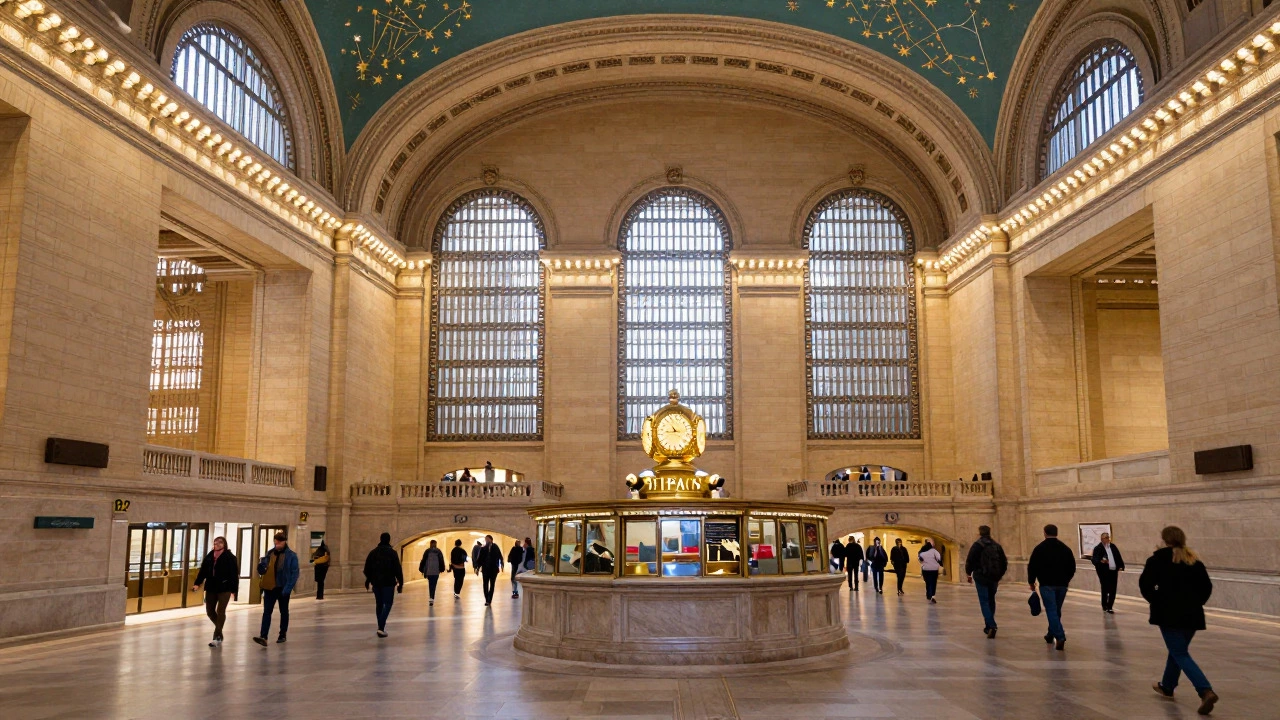
- Architectural Grandeur: The main concourse features a 125-foot high barrel-vaulted ceiling, which is the largest indoor roof in the Western Hemisphere. The ceiling is painted blue with gold stars, representing the night sky over New York City in 1894. The accuracy of these constellations is debated among astronomers, but the visual impact is undeniable.
- Cultural Icon: From the opening scene of "Annie Hall" where Woody Allen and Diane Keaton eat lunch at the iconic clock, to the dramatic chase scenes in "Spider-Man" and the romantic meetings in "Midnight in Paris," Grand Central is a character in itself. It appears in over 100 films and TV shows.
- The Preservation Battle: In the late 1960s, developers tried to replace Grand Central with an office tower called Met Life North. A group of citizens, led by Jacqueline Kennedy Onassis, fought back. The resulting Supreme Court case established new laws protecting historic landmarks across the U.S. This victory turned the station into a symbol of civic pride.
The Architecture That Defines Fame
To understand why Grand Central is so famous, you have to look at the details. The designers didn't cut corners. Every element was crafted with precision and intent.
The exterior features a limestone facade with Corinthian columns and intricate carvings. At the top sits the allegorical sculpture "Transportation," created by Jules-Félix Coutan. It depicts Mercury (speed) flanked by Minerva (wisdom) and Hercules (strength). Inside, the Main Concourse is dominated by a four-faced opal clock above the information booth. This clock, made by Tiffany Studios, is often cited as the most photographed object in the terminal.
The lighting is another key factor. When the station first opened, it was lit by 7,000 electric bulbs. Today, while modernized, the natural light filtering through the clerestory windows still creates a dramatic effect during the day. The acoustics are also unique; the concourse acts as a giant echo chamber, amplifying the sounds of trains and people, adding to the sensory experience.
| Station | Location | Opened | Key Feature | Annual Passengers (Approx.) |
|---|---|---|---|---|
| Grand Central Terminal | New York, NY | 1913 | Largest indoor roof in Western Hemisphere | 65 million |
| Union Station | Washington, D.C. | 1907 | Beaux-Arts design, major Amtrak hub | 30 million |
| Penn Station | New York, NY | 1910 (current structure) | Underground, highest volume | 600 million (commuter + intercity) |
| Union Pacific Depot | Ogden, UT | 1918 | Historic Western terminus | Low (tourist focus) |
Beyond the Commuters: Luxury and History
While most people today use Grand Central for Metro-North commutes, its history is deeply tied to luxury travel. In the early 20th century, this was the starting point for the 20th Century Limited, one of the most prestigious passenger trains in the world. Travelers boarded in silk pajamas and fine suits, heading to Chicago and beyond in private sleeping cars.
For those interested in luxury train journeys, understanding Grand Central provides context for the golden age of rail travel. The terminal housed a full-service hotel (now the Grand Central Hotel), a post office, a bank, and even a flower market. The Vanderbilt Hall, adjacent to the main concourse, featured a grand staircase and a mural depicting the history of the railroad. Although the mural was covered for decades, it was restored in recent years, revealing the artistic ambition of the original builders.
Today, the terminal continues to evolve. It houses a food hall with gourmet vendors, a branch of the New York Public Library, and various retail spaces. But the core function remains: connecting people. The fame of Grand Central lies in its ability to remain relevant while preserving its historic soul.
Other Contenders for the Title
Is Grand Central truly the only answer? Not necessarily. Depending on how you define "famous," other stations have strong claims.
Union Station in Washington, D.C. is often considered the most beautiful active intercity rail terminal in the country. Its dome, inspired by the Pantheon in Rome, and its vast waiting room make it a photographer's dream. It serves as the primary hub for Amtrak's Northeast Corridor and is a gateway to the nation's capital. If your definition of fame includes political significance and architectural purity, Union Station is a top contender.
Penn Station in New York is infamous rather than famous in a positive sense. The original Penn Station, a Gothic Revival masterpiece, was demolished in 1963 to make way for Madison Square Garden. This demolition sparked the preservation movement that saved Grand Central. Today's Penn Station is a sprawling underground maze. It is famous for being confusing, crowded, and essential. For sheer volume of human traffic, it wins, but for prestige, it loses.
Chicago Union Station holds a special place in history as the meeting point of the transcontinental railroad. The Pullman Porters' history and the station's role in the Great Migration give it deep cultural significance. Its current renovation aims to restore its former glory, making it a rising star in the world of historic rail travel.
Visiting Grand Central: A Practical Guide
You don't need a train ticket to experience the fame of Grand Central Terminal. Here’s how to make the most of a visit:
- Visit the Main Concourse: Go early in the morning or late at night to avoid crowds. Look up at the ceiling and try to spot the reversed constellations (they are painted as if viewed from below).
- See the Whispering Gallery: Located near the ticket booths, this arched alcove has perfect acoustics. Stand in one corner and whisper to a friend standing in the opposite corner; they will hear you clearly despite the distance.
- Eat at the Food Hall: The lower level offers a variety of dining options, from artisanal cheese shops to sushi bars. It’s a great place to see the diverse crowd that uses the station.
- Take a Tour: The Grand Central Guided Tour program offers access to restricted areas, including the upper levels and the historic offices. It provides deeper insights into the station's secrets.
- Check Out the Clock: The Tiffany clock above the information booth is a landmark within a landmark. Take a photo, but remember to respect the space around it.
The Future of Historic Rail Travel
As interest in sustainable travel grows, historic train stations like Grand Central are seeing renewed attention. Luxury train operators are increasingly partnering with historic hubs to offer premium experiences. Imagine boarding a sleeper car at Grand Central, heading north to Boston or south to Washington, enjoying the romance of rail travel without the stress of airports.
The station's ongoing renovations ensure it will remain functional for decades to come. New entrances, improved accessibility, and updated technology are being integrated without compromising the historic fabric. This balance between preservation and progress is what keeps Grand Central relevant and famous.
In a world of fast-paced digital connectivity, Grand Central Terminal stands as a reminder of a time when travel was an event, not just a transaction. Its fame is not accidental; it is the result of deliberate design, cultural resonance, and a community that refused to let it disappear.
What is the most famous train station in the United States?
Grand Central Terminal in New York City is widely considered the most famous train station in the U.S. due to its iconic architecture, appearance in numerous films, and historical significance in the preservation movement.
How many platforms does Grand Central Terminal have?
Grand Central Terminal has 44 tracks and 11 platforms, making it one of the busiest train terminals in the world. These are spread across two levels: the Upper Level and the Lower Level.
Is Grand Central Terminal open to tourists?
Yes, Grand Central Terminal is open to the public 24 hours a day. Visitors can explore the Main Concourse, the Whispering Gallery, and various shops and restaurants without needing a train ticket.
What is the difference between Grand Central and Penn Station?
Grand Central Terminal is primarily served by Metro-North Commuter Railroad and features historic above-ground architecture. Penn Station is an underground hub serving Amtrak, NJ Transit, and Long Island Rail Road, known for its high passenger volume but lacking historic grandeur.
Can you stay overnight at Grand Central Terminal?
There is no dedicated hostel inside Grand Central Terminal, but the nearby Grand Central Hotel offers luxury accommodations. Some travelers do sleep in the station's waiting areas, though it is not officially encouraged.
What is the Whispering Gallery at Grand Central?
The Whispering Gallery is an arched alcove located near the ticket booths. Due to its unique elliptical shape and hard surfaces, sound waves travel efficiently along the arch, allowing whispers to be heard clearly from one end to the other.
Why is the ceiling of Grand Central Terminal blue?
The ceiling is painted blue with gold stars to represent the night sky over New York City in 1894. It is a decorative feature intended to evoke a sense of wonder and openness within the enclosed space.
Did any famous trains originate from Grand Central?
Yes, the 20th Century Limited was one of the most famous luxury passenger trains to depart from Grand Central Terminal. It ran from New York to Chicago and was known for its speed, comfort, and elegance.